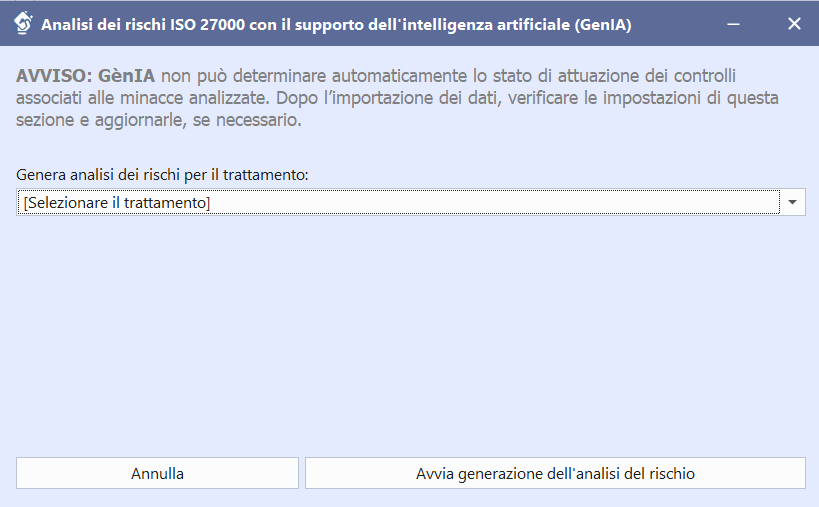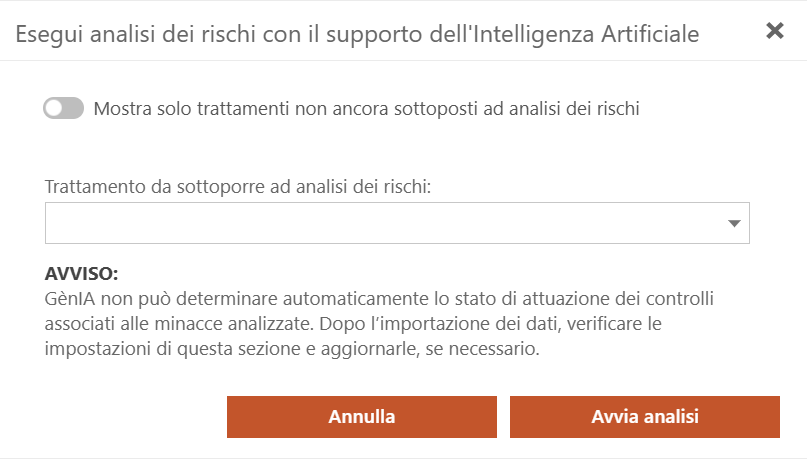
Select the processing activity already present in the project and let GènIA help you build a risk analysis consistent with the ISO 27000 procedure logic, starting from the already recorded information and structuring its values.
No new documents to upload: the only input is the selection of a processing activity already present in the project.
Minimal input
Selection of the processing activity already recorded, without duplicating information or writing new text.
Structured analysis
CIA values, threats, security controls, and risk treatment plan.
Project consistency
The risk assessment remains aligned with the context, operational methods, and existing assets.
The feature is designed to speed up the preparation of risk analyses and improve continuity between processing and assessment.
Build consistent risk analyses across different processing activities, maintaining a uniform logic and a document base aligned with the project.
Reuse the context already recorded in the processing activity and reduce the time spent reconstructing already known information.
Risk analyses remain closer to actual processes because they start directly from defined and updated processing activities.
A guided path starting from the selected processing activity to build a more organized and consistent risk analysis base.
The only input required is choosing a processing activity already present in the project. It is not necessary to upload new documents or compile new descriptions.
GènIA leverages the information already associated with the processing activity: definition and extended description, data processed, operational methods, security measures, and organizational context.
The information handled by the processing activity is evaluated in terms of Confidentiality, Integrity, and Availability, creating a consistent base for the analysis.
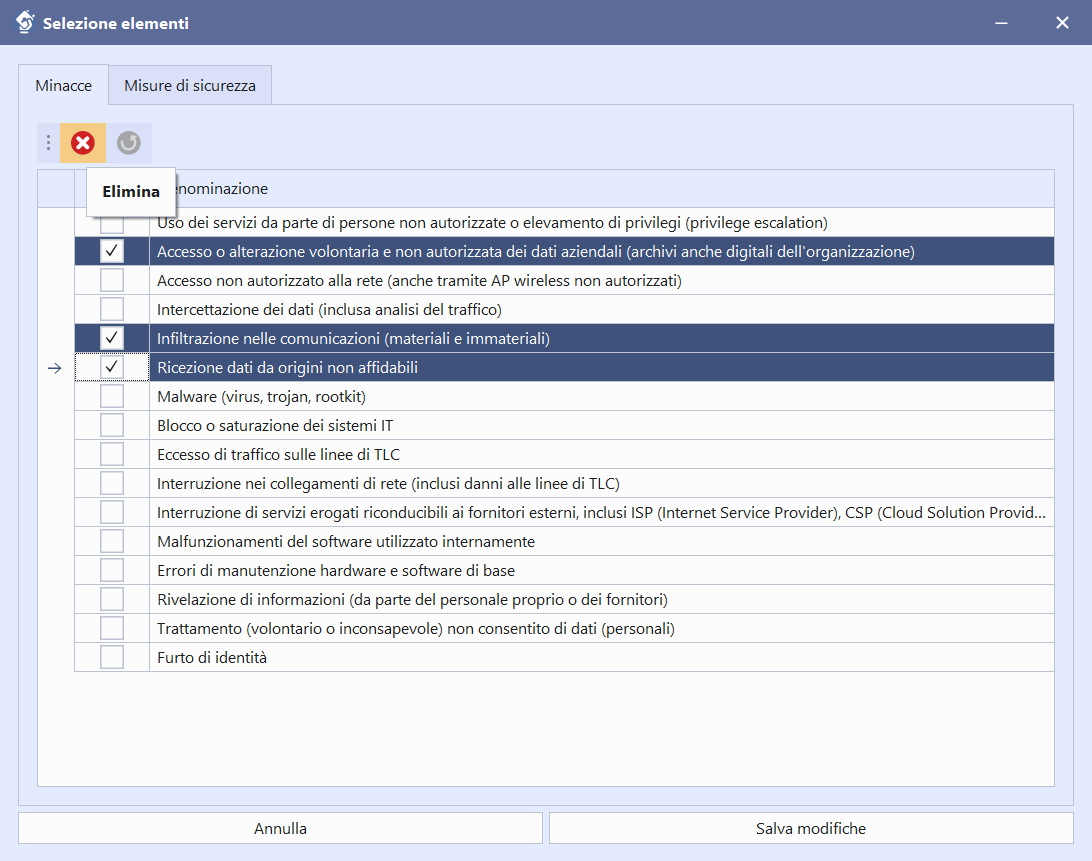
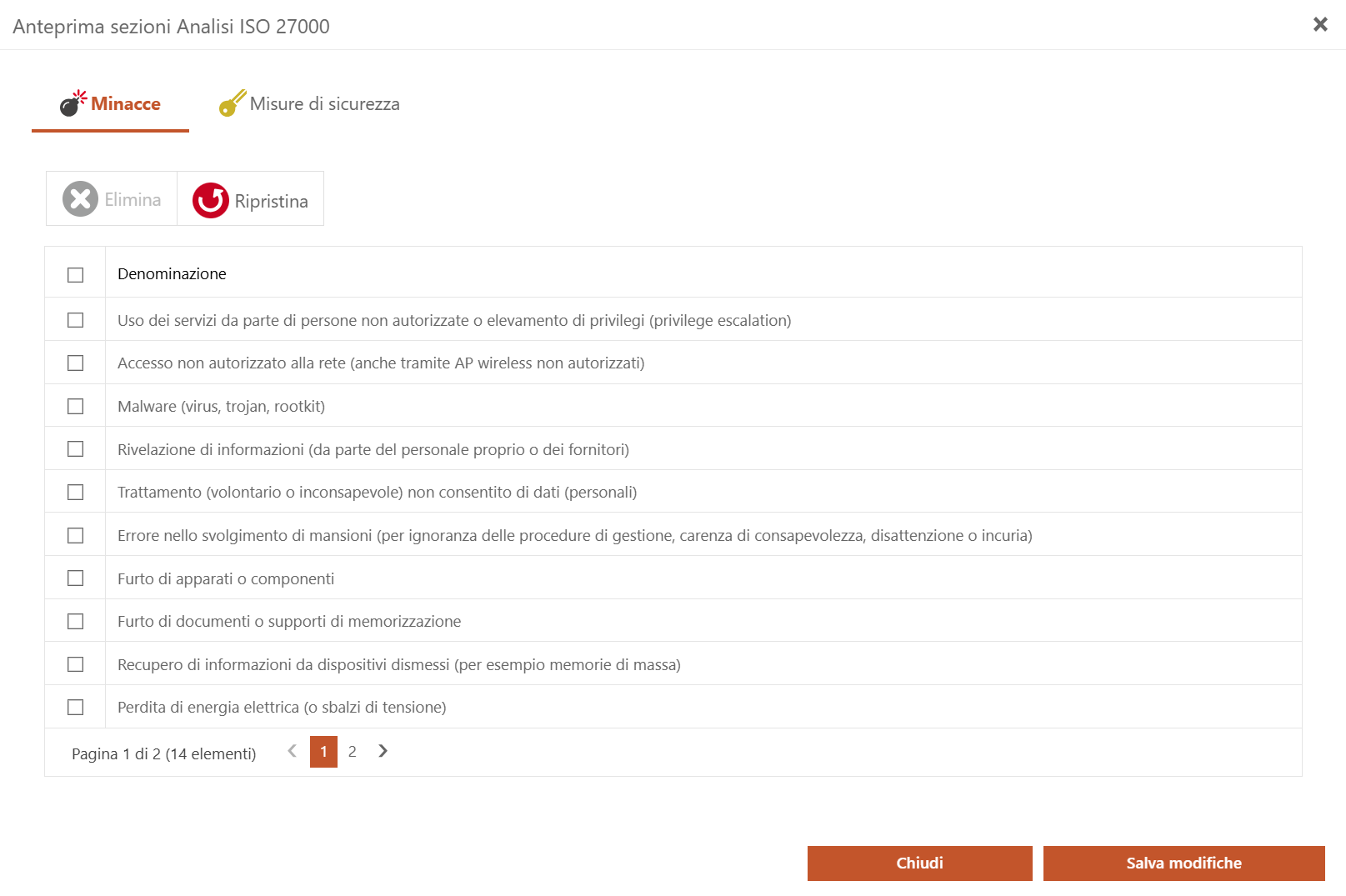
Based on the processing carried out, GènIA deduces the threats to the data and provides an evaluation of their likelihood.
The feature associates security controls consistent with the detected threats and contributes to a preliminary assessment of their adequacy.
The analysis base is completed with the construction of the risk treatment plan, including, if necessary, new measures and the threats each measure counters.
The goal of the feature is to speed up the preparation of the analysis, not to replace the professional's work. GènIA provides a more organized and consistent evaluation base, but contextualization, review, and final validation always remain the responsibility of the DPO or consultant.
The feature reorganizes the processing activity information technically and coherently to build a more complete risk analysis base.
Attribution of Confidentiality, Integrity, and Availability values to the information handled by the processing activity.
Deduction of relevant threats based on the processing carried out and evaluation of their probability/likelihood.
Association of security controls, preliminary verification of their adequacy, and construction of the risk treatment plan.
Since the feature starts from an already recorded processing activity, the risk reading remains anchored to the real information of the project: this helps reduce inconsistencies between the operational context, identified threats, and proposed measures.
The analysis does not require new data collection: it uses what is already present and reorganizes it according to a logic useful for the assessment, reducing repetitive work and improving the quality of the starting base.
The same principles apply to consumption as the other Global Analysis features: clarity before starting and control by the professional.
Before processing, the system estimates the required AI requests and checks the availability of the active package.
The processing load depends mostly on the richness of the information already present in the selected processing activity.
If the package is not sufficient, the system notifies you before generation, avoiding interruptions in the workflow.
Since the ISO 27000 analysis reuses the already recorded processing activity, consumption largely depends on the amount of information present (data, purposes, operational methods, etc.) and the correlations between information to be reworked in the risk assessment.
Transparency on consumption goes hand in hand with control over content: first, you evaluate the sustainability of the request, then the professional verifies and completes the analysis base produced by GènIA.
A visual overview of the feature's main screens, with examples for Privacy Evo Desktop and Privacy Evo Web. Click on the thumbnails to open the enlarged image on the same page.
Register for the March 6th presentation Webinar on Global Analysis with GènIA. Not available on that date? Contact us.
Frequently asked questions about ISO 27000 Risk Analysis.
The only required input is the selection of the processing activity already present in the project. No new documents or additional texts are needed.
GènIA supports the attribution of CIA values, deduction of threats, likelihood assessment, association of controls, and construction of the risk treatment plan.
Because it avoids duplications, maintains consistency between the processing and the risk analysis, and reuses the context already present in the project.
It mostly depends on the quantity and complexity of the information already present in the processing activity, particularly the operational methods to be reprocessed.
No. GènIA produces a structured working base; review, contextualization, and final validation always remain the responsibility of the professional.
No. The goal is to speed up the construction of the analysis base, not to replace the technical and professional judgment of the DPO or consultant.